
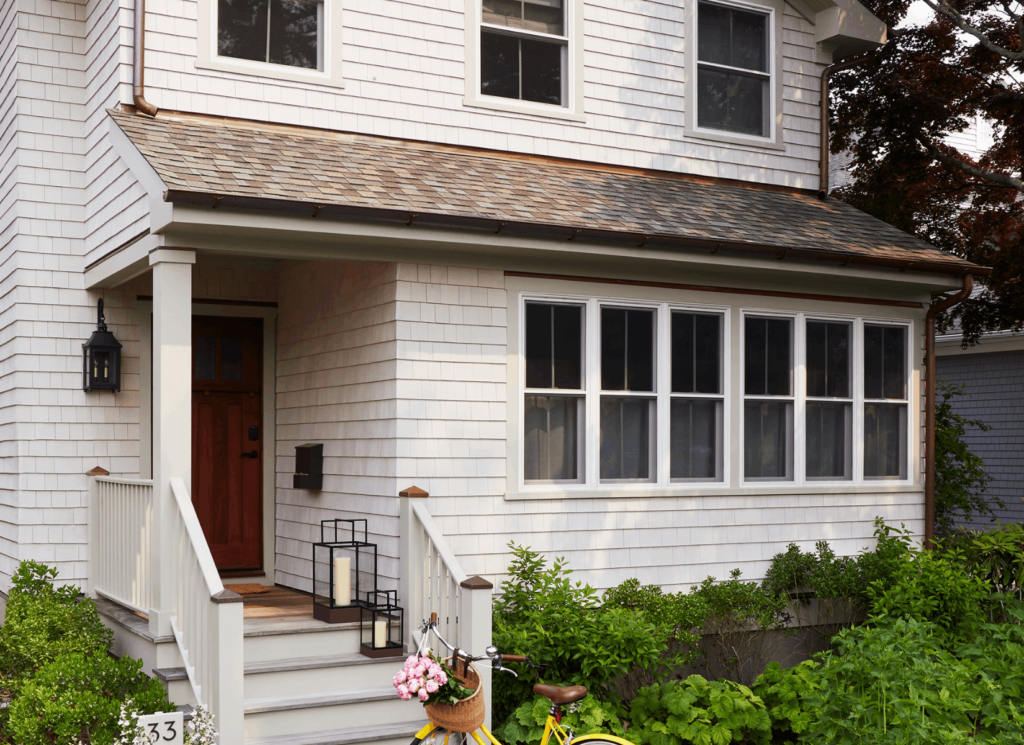
There’s a version of a shore day I’ve been chasing since we first started renting a summer place in Spring Lake-a day spent reading on the porch, with zero guilt felt. I’m inching closer to this goal with our Manasquan cottage, which we found after years of searching for our “forever” shore home. I arrived with my “major project” fantasy of a gut renovation and a blank slate. My husband had other ideas. The compromise we reached taught me something I’ve carried into every shore project since: the best-designed shore homes aren’t built from scratch. They’re built around how a family actually wants to spend a summer.
This is my edit, the things I reach for, invest in, and recommend to clients designing (or redesigning) for life at the shore. If there’s a single principle behind all of it, it’s this: good Jersey Shore summer home design isn’t about buying more. It’s about choosing the few things that earn their place in a summer.
01. An outdoor dining table that gets used
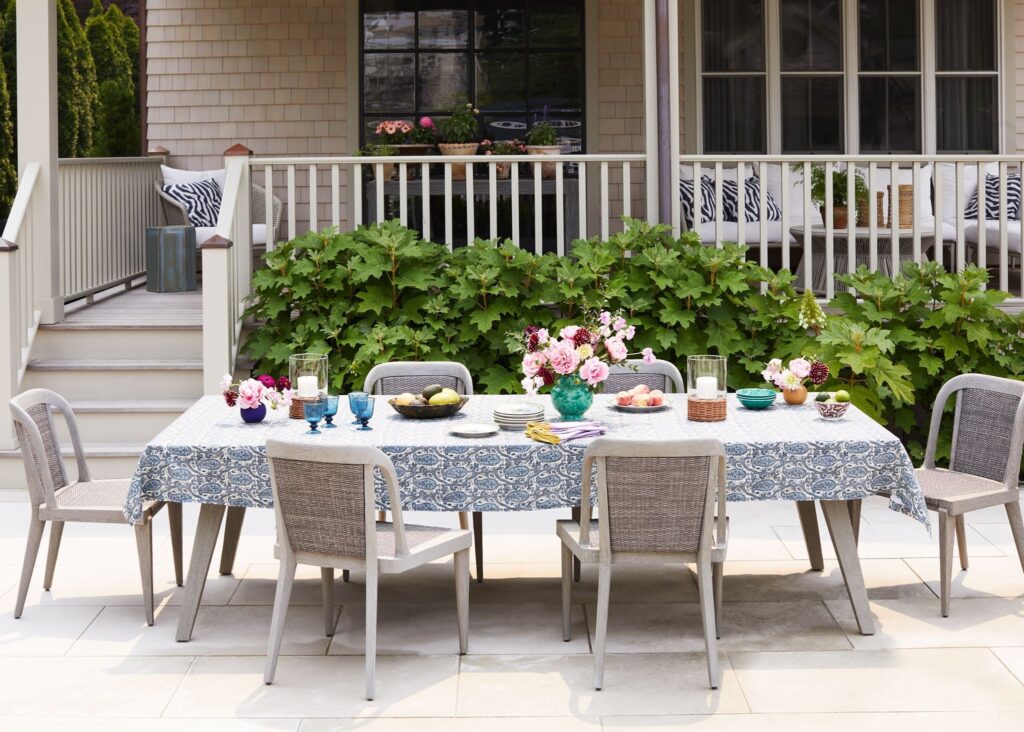
This is where I’d start, every time. The outdoor dining moment is the center of shore life. It’s where you eat, where you linger after dinner, where guests end up whether you planned it or not. It earns more hours than almost any other piece of furniture in the house.
We have a Janus et Cie table and chairs, and I’d recommend them without hesitation. They’ve been engineering outdoor furniture for over forty years, and the material quality shows — the woven fiber holds its color and structure in conditions that would destroy lesser pieces. Salt air, humidity, full sun: these are pieces designed to actually live outside, not pieces that happen to be placed there. And the design level is high enough that you’re not making an aesthetic compromise to get the durability.
The table also needs to be big enough. The thing shore clients consistently underestimate is scale: they buy for the immediate family and end up with nowhere to seat the people who show up on a Saturday afternoon. At the shore, size up. Someone always shows up.
I like to keep the table styled for a casual brunch or lunch, where hosting feels effortless but still thoughtful. The blue patterned tablecloth is from Cabana, and it brings just the right amount of color and character without feeling overly formal. That balance of ease and informal elegance is exactly what I want an outdoor dining space to feel like.
02. A daybed someone will actually sleep on
The pool house or outdoor lounging moment is the other piece I think about early in every shore project. Not a pair of pool chairs that sit parallel to the water forever, but a daybed: one piece wide enough for two, substantial enough to feel intentional, with cushions you’d actually want to lie on for an hour.
The daybed is a custom piece from The Raj Company that I designed with a trundle underneath, allowing it to accommodate more guests without taking up additional space. I wanted it to serve as both a practical solution and a true design moment, so I layered it with pillows in different colors and patterns to add personality and warmth. It’s a piece that invites people to gather, stretch out, read, nap, or simply spend the afternoon together.
When it comes to outdoor textiles, my approach is probably different from what people expect. I don’t gravitate toward performance fabrics, as many are made with petrochemicals or forever chemicals. Instead, I prefer natural materials that age honestly over time. Shore homes are meant to be lived in, and I embrace the signs of that. Our dog loves cooling off on the first step of the pool before jumping onto every upholstered surface she can find, and that’s part of the story, too. I’d rather choose materials I love and accept a little wear than create a space that’s too precious to enjoy.
03. The right outdoor shower
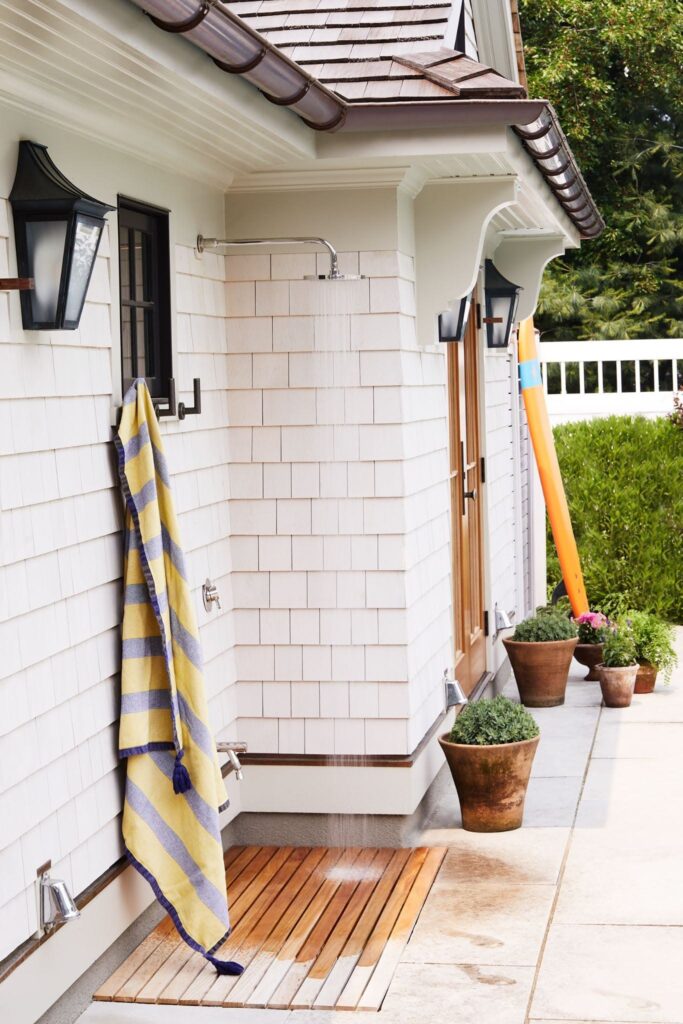
This is the small thing that makes a shore home feel considered. A well-designed outdoor shower, with good fixtures, real pressure, and a sense of being a destination rather than an afterthought, transforms the end of a beach day. It also keeps the sand out of your interior better than anything else you can do.
At our own shore house, we were highly constrained by the lot size and the maximum amount of hardscape already allowed on the property, so a full outdoor shower wasn’t possible. Instead, we designed a simple body and foot rinse station, and I honestly love it. It sits alongside the pool house and has become one of those features we use constantly after coming back from the beach or rinsing off by the pool. It may be a modest solution, but it’s proof that even with limitations, thoughtful design can make everyday routines feel intentional.
04. Linen and natural fiber, everywhere
Inside the Manasquan house, linen does more work than any other material. I reach for it at the shore for the same reason I reach for it in the city: it softens beautifully, it breathes, and it looks better the more it’s used. A linen sofa that’s a little rumpled at the end of a weekend feels right in a way a tightly upholstered one never does by the water. Throughout the house, I also layer in cotton and wool, which bring softness, warmth, and texture without sacrificing that relaxed feeling.
For rugs, natural fiber is the obvious answer. Jute, seagrass, and sisal handle sand and water better than most pile carpets, and their texture feels elevated without being precious.
This is the thread running through everything I choose at the shore: the materials that get better with time are always the right call. Unlacquered brass that patinas, linen that softens, wood that gains warmth and depth. Rather than pre-distressed finishes that arrive already looking “done,” honest materials develop character slowly. Over time, that lived-in quality feels real, because it is.
05. Custom tilework in the right places
Concrete Collaborative makes handcrafted concrete and terrazzo tile that moves seamlessly from interior to exterior: floor and wall, exterior pavers, pool coping, countertops. We used their tile in the pool house, and it’s one of those choices that rewards you every time you look at it. The variation in handcrafted concrete is the point. It reads as material, not surface.
It also ages well, which matters here. Salt air and humidity are hard on finishes. Materials that take on patina gracefully, like tile and unlacquered hardware and natural stone, will always outlast anything trying to stay pristine.
06. Lighting that earns its place
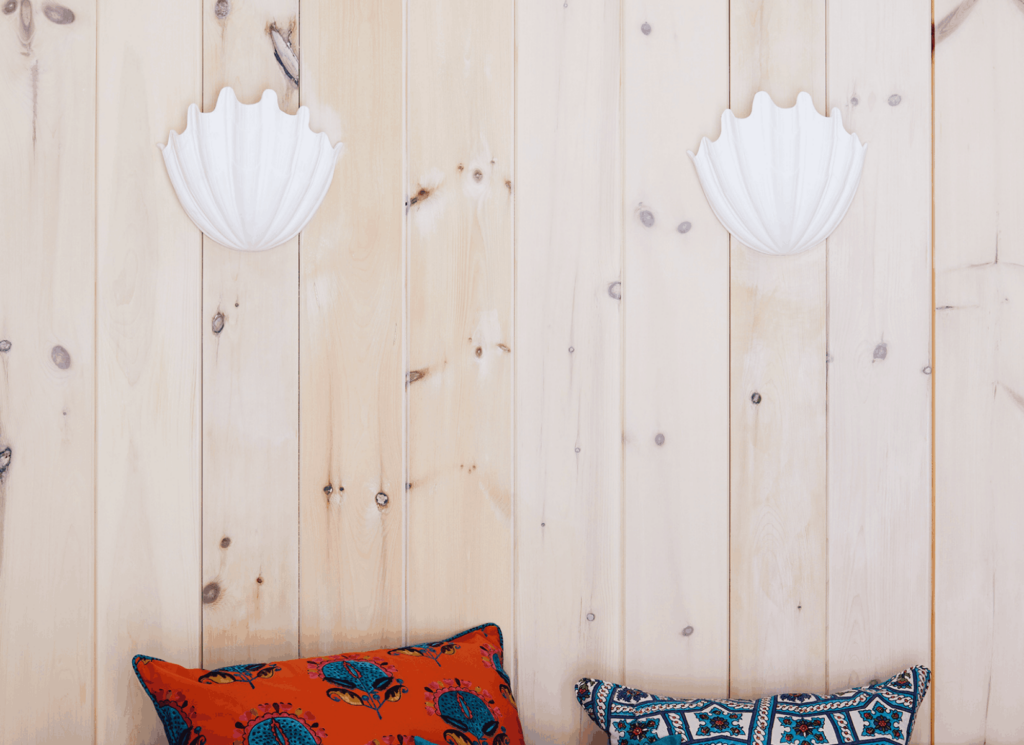
Lighting is the most overlooked element in shore design, full stop. Clients invest in the furniture, the tile, and the textiles, then reach for basic fixtures at the finish line. Pool house and transitional lighting deserves the same consideration as everything else. It’s what makes a space somewhere you actually want to be at 9pm.
In our pool house, the plaster sconces from Rose Uniacke do most of the work, mounted on the whitewashed pine walls of the main studio. Plaster is exactly the right material for the shore: it reads as soft and architectural at once, and it ages without fuss. The Henry Wilson Surface Sconce is in our pool house, and I’d put it in every project if I could. It’s a sculptural piece — cast in solid bronze or cut from natural stone, made in small batches so each one is slightly individual. The bronze version is particularly well-suited to the shore: it comes with a bright finish that weathers over time into a deep, distinctive patina. Rather than fighting the salt air, it responds to it. That’s exactly the quality I look for in a coastal context.
07. Art, even at the shore
This is the thing clients most often skip, and the thing that most reliably takes a shore home from decorated to designed.
I approach art the same way at the shore as I do in the city: it’s the starting point, not the finishing touch. Rather than obvious nautical themes, the coastal note can be woven in through curated accessories and commissioned pieces. That’s the difference between a home that feels coastal because it’s responding to its environment and one that’s announcing a theme.
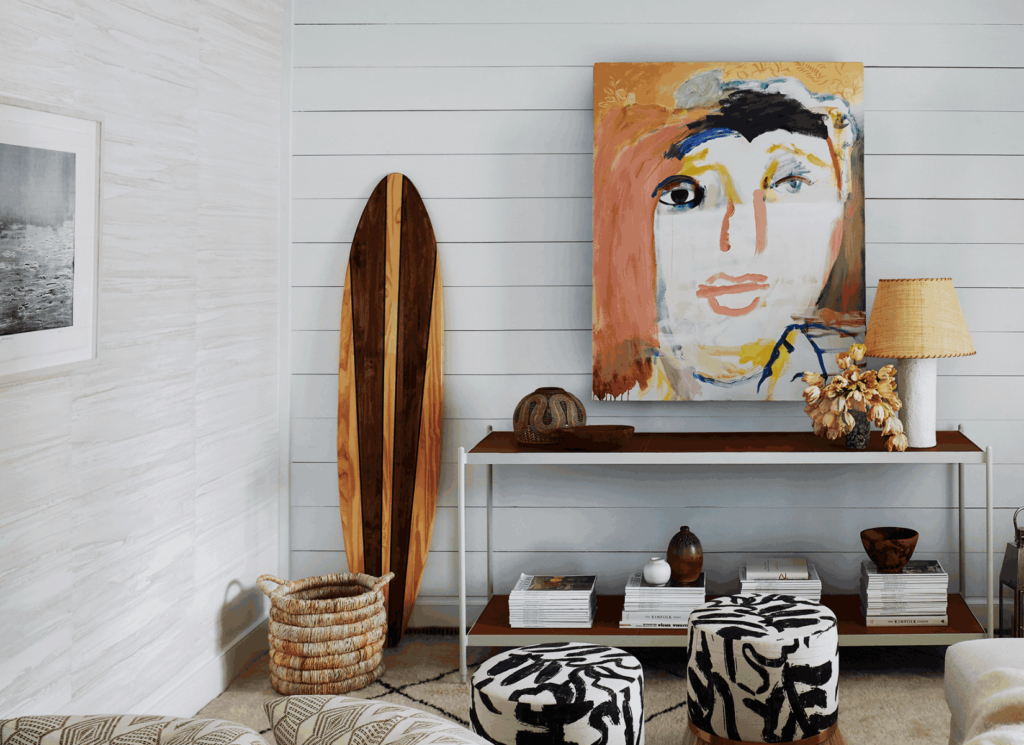
In our Manasquan family room, a Margot Bergman portrait hangs above the console. It has nothing to do with the beach and everything to do with why the room feels like a home rather than a rental. That’s the work art does: it personalizes a space in a way no furniture can. Art is where I begin, not where I finish.
08. A terrazzo table worth the wait
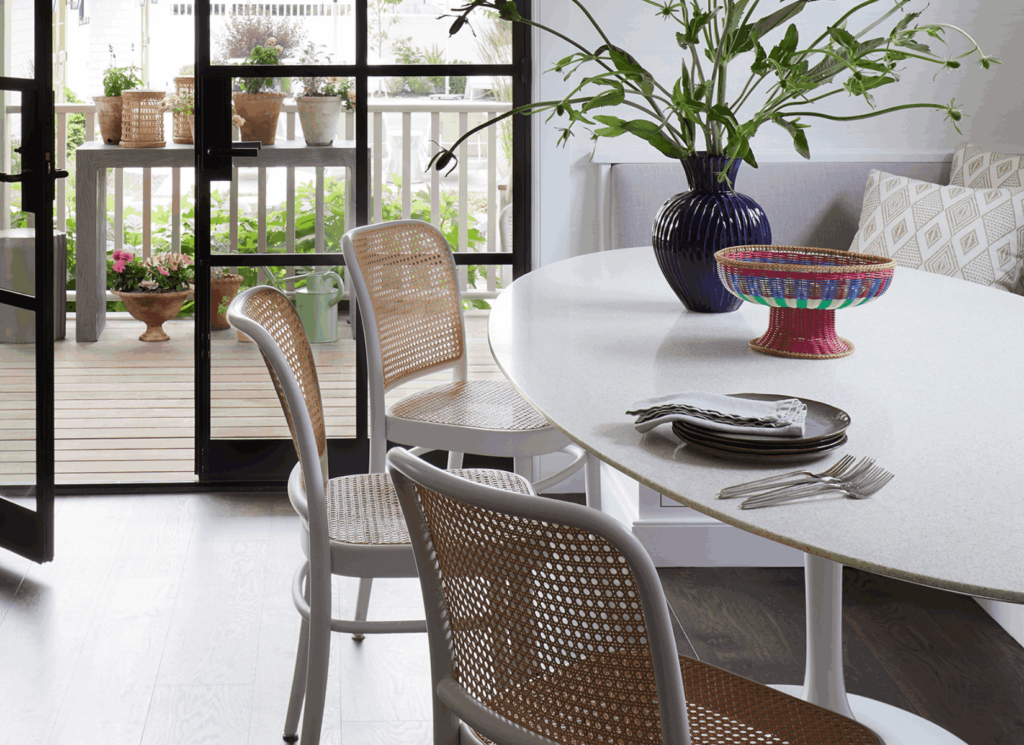
Most shore-home advice points you toward distressed wood. I went the other way. Our dining table is a single slab of terrazzo I made with artisan Robert Sukrachand, so heavy it took four people to set it in place. It’s the piece I’m asked about most, and it’s the clearest example of what I mean by choosing fewer things that earn their place: one custom table does more for the room than a cart full of decorative objects ever would.
Terrazzo also happens to be the right material for the job. It shrugs off sun and spills and a decade of sandy elbows, and the surface only looks better as it wears. The case for commissioning a piece like this isn’t just that it’s beautiful. It’s that it solves the shore problem (a table that has to feel expansive when extra people arrive, and they always do) in a way nothing off a showroom floor can.
09. Pattern that commits
One thing I see again and again in shore homes that fall a little flat: pattern that hedges. A stripe too timid to register, a print that’s holding something back. At the shore, where you’re competing with the most dramatic visual environment there is, tentative pattern just reads as noise.
In our guest bedroom, I layered Quadrille wallpaper with Elizabeth Eakins drapery, blues and reds built up across scales, consistent in temperature but varied in intensity. The result feels collected rather than coordinated, which is the whole difference between a room that looks considered and one that looks like a catalog page.
The principle holds whether you’re papering a guest room or choosing a tablecloth for the outdoor table: commit to the pattern. It will hold up. The safe choice rarely does.
10. The one thing that pulls it all together
The best shore homes I’ve designed, including the one I live in, share one quality: they feel like the people who live there actually made choices. Not “beach house” defaults like the driftwood and the rope and the “BEACH” stenciled on a plank, but specific, considered, personal choices that happen to exist near the water.
That’s not a furniture recommendation. It’s a philosophy. Before reaching for any themed accessory, ask what you actually love about being near the water: the quality of light, the indoor-outdoor rhythm, the way materials weather, the colors of an ocean sunset. Those are the cues worth designing around. A home that responds to them feels coastal because it’s true, not because it’s been decorated to look the part.
Ready to design a shore home that actually reflects how you live? View the Manasquan project or get in touch to start the conversation.

Leave A Comment