
I would rather wait nine months for the right thing than have the wrong thing by Friday. This is not a popular position.
In most projects there comes a point where I stop looking through vendor catalogs and start calling people instead. Not because nothing exists that would work. Because the thing I am picturing does not exist yet, and somewhere out there is a person who has spent twenty years learning how to make exactly what I’m looking for.
That choice, to commission rather than source, is probably the single decision that most defines how we work. Most of the artisan furniture in our NYC projects starts as a phone call rather than a purchase order.
What changes when you commission artisan furniture
A sourced piece is a solution. A commissioned piece is a collaboration, and it arrives carrying the fingerprints of at least two people who cared about how it turned out.
Three things shift when you go this route. One, you get creative input into the form itself. Two, you get to choose the material, which is usually where the real decisions live anyway. And three, you end up with something that exists exactly once, sized and finished for the room it will spend its life in.
None of that is about extravagance. It is about specificity. A room asks a particular question, and a commissioned piece is an answer written for that question rather than borrowed from someone else’s. It is also, practically speaking, how a house comes to feel collected over time rather than decorated all at once. You cannot buy that quality. You can only accumulate it.
How I find people
I find artisans and craftspeople a few ways, and my favorite is travel. Some of my favorite discoveries have come from wandering into a workshop in a place I do not live. Beyond that I lean on referrals from design colleagues, vendor representation, and (I will be honest) Instagram and the internet, which have made it possible to follow someone’s work for years before you ever send the first email.
Vetting is a trust-fall process. I look through prior work in a portfolio, and then I go largely on gut feel from our first conversation. That first conversation usually tells me a lot about whether our instincts and working styles are going to align. That conversation matters, and as I will get to, the one time a collaboration went badly on me, it was because I had not spent enough time in it.
What a commission brief looks like
I give dimensional and construction-related parameters, and then I let artisans do what they do best. That is genuinely the whole method.
If I over-specify, I leave very little room for the artisan to bring their own point of view to the piece, which defeats much of the reason I called them in the first place.
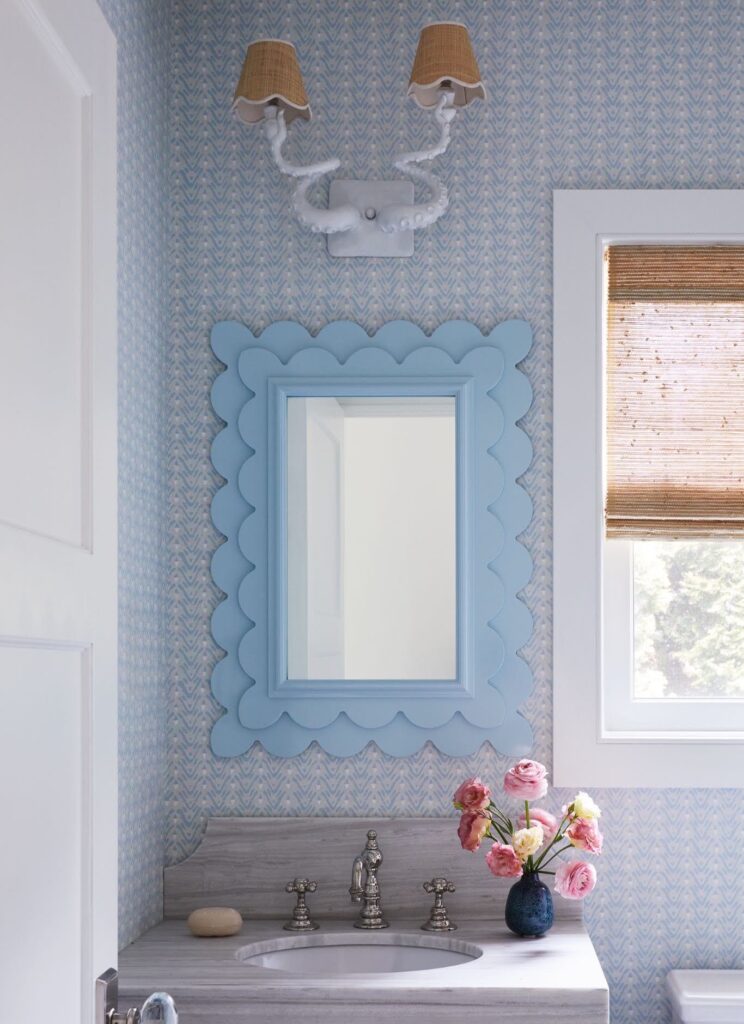
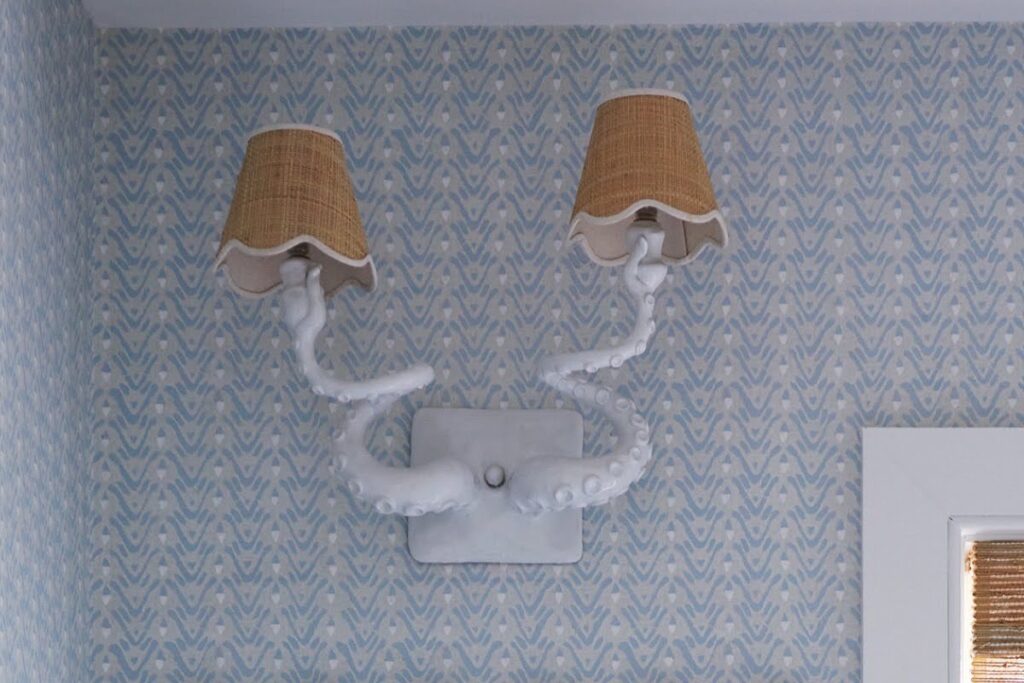
The powder room sconce in our Manasquan house is the clearest example I have. I knew what my dimensions were and I knew I wanted two sources of light. Those were my constraints, and that was the extent of them. Everything else belonged to Adam Wallacavage, whose work I had been quietly stalking for some time. His octopus arm light fixtures turned out to be exactly the right solution for that room. I believe Adam asked for my color preference, and from there it all unfolded easily.
That is the advantage of leaving room in the brief. I knew what the fixture needed to do and where it needed to fit, but I did not prescribe what it had to become. The result was an octopus, which was better than anything I would have thought to ask for.
The trust fall
Sometimes I am amazed that it lands.
I recently asked Studio Amos to custom weave inset panels for a custom vanity. Collaborating with furniture makers across an ocean is an unreasonable thing to attempt on paper. The cabinetry frame is not flexible, so the panels had to be exact. I was working between two different trades who had never spoken to one another. And Studio Amos is based in the UK while my millworker is here in the US, which meant that any dimensional misunderstanding would not reveal itself until something came out of a crate.
Every i was dotted and every t was crossed. It came together beautifully. But I would be lying if I said I was not holding my breath.
The one that did not work
It has happened to me once, early in my career, and it was expensive enough that I have never repeated it.
I was designing a room and the custom painted ceiling did not turn out the way I had hoped. The timeline was already compressed, so there was no room to solve the problem gracefully. I contracted a second decorative painter to redo the ceiling. It worked out in the end. It also cost me twice.
The lesson was not about the first painter’s skill. It was that I should have spent far more time in the discussion phase, where I would have found out that our styles simply differed too much for the work I was asking for. That failure is the reason I now treat the first conversation as the most important part of the process rather than a formality to get through before the real work starts.
Good things take time
This is usually where I do some of my most useful work as a guide.
We all lived through the production slowdowns. And yet there is still a pervasive expectation of drop-ship, instantaneous gratification, even when it comes to handmade work. I am often brought onto a project that a client wanted finished yesterday and helping them see why something truly special is worth the wait takes patience on both sides.
What I try to convey is the trade. You can have something quickly, or you can wait for something made specifically for you and designed to last. The wait is not a flaw in the process. It is the process. Someone is making a thing by hand, once, for you.
Custom is a sustainability position
This part is easy. Things that are custom made are inherently more special and more personal, and more likely to last than something ordered online simply because it looked good in a photograph.
Longevity is the most underrated environmental strategy in this industry. A piece that gets kept does not need to be replaced, shipped, or landfilled. When I talk about sustainable design, I am often talking less about certifications and more about whether something is good enough that people will want to keep it.
Beautiful and useful
A lot of my commissioned work is site-specific. Custom lighting, a motorized side table, elements built into the architecture of a particular room. Their integration into their environment is exactly what makes them so well suited to it, which also means I expect most of them to be sold along with the houses they live in. So far the original owners are still living with them. I will report back in a few decades.
Beyond material and construction, though, what makes a piece last is simpler than people expect. It has to be both beautiful and useful. That pairing is design perfection. Beauty alone is not enough, and neither is utility. The pieces people keep tend to have both.
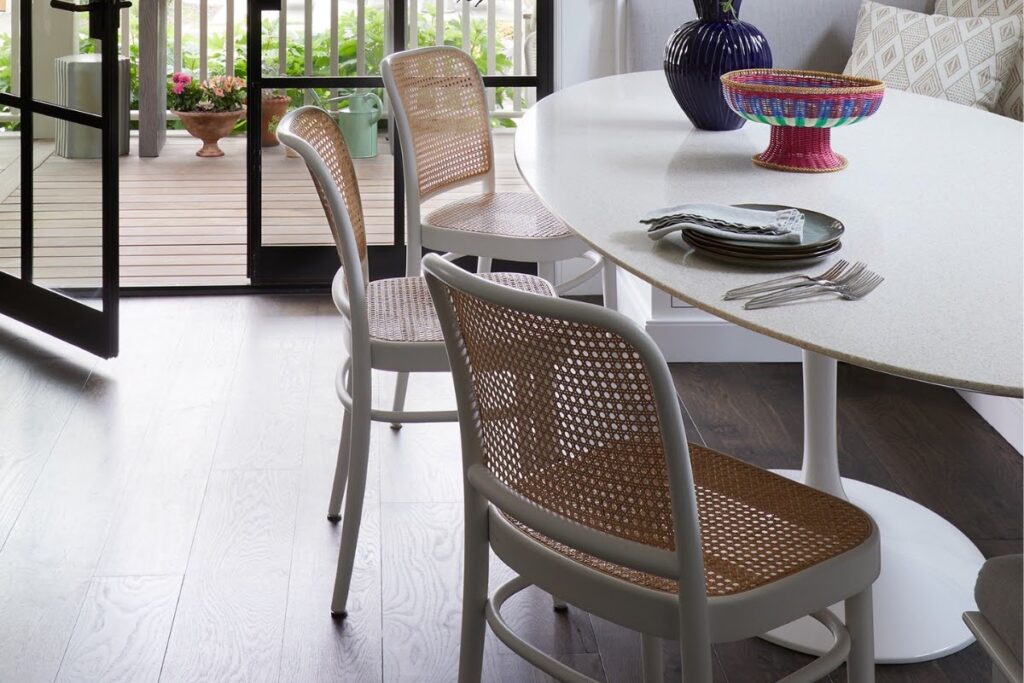
The terrazzo dining table Robert Sukrachand made for our Manasquan house is my shorthand for all of this. It is cut from a single slab, substantial enough that four people were needed to install it. It is also where we eat dinner.
Why I will not name a favorite
People ask me to name a favorite craftsperson and I refuse every time. It is too hard, and it is also slightly the wrong question. There is an artisan I love for every medium.
The skill is not in having one great maker on speed dial. It is in knowing who to call when the problem is plaster, or glass, or weaving, or a single slab of terrazzo, and then to give that person room to do what they do best.
Sourcing is a search. Commissioning is a relationship, and the pieces that come out of it are the ones clients point to first when they walk someone through their house. That is what livable art looks like in practice: not a room that photographs well, but a room full of things that somebody made on purpose.
Laura Krey Design creates custom, commissioned work for whole-home projects in New York City and across the Jersey Shore. If there is a piece you have been picturing that does not exist yet, get in touch or see the Wyckoff Cottage project to see her approach in action.

Leave A Comment